

FGS: from neglect to a win for women’s health

Five years ago, female genital schistosomiasis (FGS) barely registered as a global health priority. By 2025, The World Health Organization (WHO) had convened its first-ever consultation on the condition, donors had made their first public investment commitments, and several countries across Africa were integrating FGS into national health systems. That shift did not happen by accident.
FGS affects up to 56 million women and girls across Africa.
Caused by parasitic worms in rivers and lakes, it can cause inflammation, open sores and bleeding on the cervix and vagina, which can have a severe impact on women’s day–to–day wellbeing, and increase their risk of cervical cancer, HIV transmission and accelerating HIV progression.
Yet for years it has been classified as a neglected tropical disease, with little attention given to its serious sexual and reproductive health implications.
Frontline AIDS has worked since 2020 to close that gap.
We co-founded and co-chair the cross-sector FGS Integration Group, building the evidence base, partnerships and advocacy needed to shift how the condition is understood, funded and treated.
Central to this has been proving that integrating FGS within other sexual and reproductive health services is feasible.
Our FGS Integration Project, funded by The Children’s Investment Fund Foundation and delivered with LVCT Health and Bridges to Development, tested a minimum service package across three counties in Kenya.
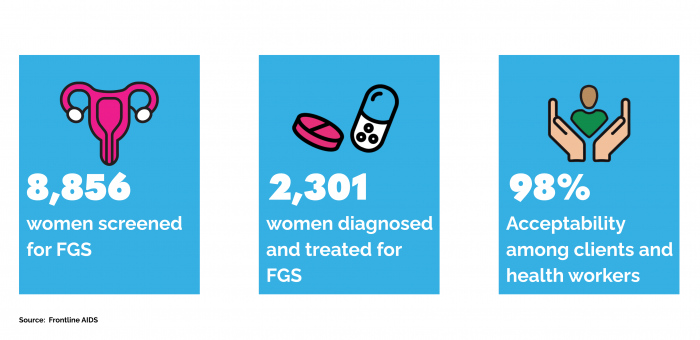
Between 2023 and 2024, 8,856 women were screened, with 2,301 diagnosed and treated. Acceptability among clients and health workers was 98.8%. That evidence is now shaping how countries across the region approach FGS and SRH integration.
In 2025, this sustained effort produced its most significant results. Frontline AIDS contributed directly to the WHO genital schistosomiasis taskforce and attended the first-ever consultation in Geneva. WHO developed messaging explicitly linking FGS to HIV, incorporating the minimum service package developed by Frontline AIDS.
At country level, the results are tangible:
- In Malawi, a community advocate, supported by Frontline AIDS through Women4GlobalFund secured the inclusion of the FGS prevention and treatment medicine, praziquantel, on the Global Fund procurement list, embedding it in global product planning.
- In Kenya, years of partnership with organisations, including LVCT Health, laid the groundwork for Homa Bay county procuring praziquantel for the first time.
- In Nigeria, Frontline AIDS worked with the FGS Society of Nigeria, Education as a Vaccine and Unlimit Health to develop and trial a landscape analysis tool for country-level FGS integration. The results directly informed its adoption by WHO’s Expanded Special Project for Elimination of Neglected Tropical Diseases programme for rollout across Africa — a process which is now underway.
I was so happy to see the government, through the Ministry of Health, set aside funding for the procurement of praziquantel drugs used to treat schistosomiasis. This taught me how powerful advocacy can be in influencing policy decisions and mobilising resources to address neglected health issues affecting women and girls.Linda Phiri, Community Mobiliser, Malawi
Systems change is slow. But through sustained advocacy, communications and strategic partnerships built over five years, and the donors who backed it, Frontline AIDS’ work is now producing results that will improve the quality of life for millions of women and girls for decades to come.