

Driving Change Across MENA: the Nadoum Story

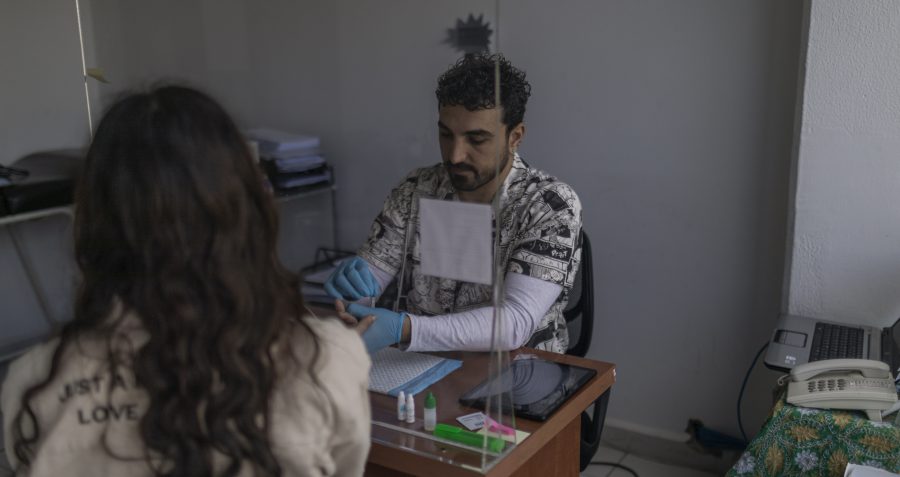
The MENA region has experienced deep challenges in the fight against HIV. In a place where hope often feels scarce, determination runs deep, says Golda Eid, Programmes Lead at Frontline AIDS.
Nadoum, Frontline AIDS’ programme in the Middle East and North Africa (MENA) region, launched in 2019 with funding by the Global Fund and worked across Egypt, Jordan, Lebanon, Morocco, and Tunisia. Marginalised communities face criminalisation and stigma and, adding to the challenges, underfunding, and political complexity make the MENA region one of the hardest places in the world to provide HIV and sexual and reproductive services and care. Nadoum didn’t deliver services directly, but instead strengthened communities, empowered civil society, and tackled the barriers that prevent key populations – men who have sex with men, gay men, sex workers, people who use drugs, trans people, and people living with HIV – from getting the care they need.
working together in a Challenging environment
Nadoum partnered with 23 national and regional organisations and networks, while actively engaging governments, regional coalitions, and international donors to ensure that work was context-sensitive and aligned with broader regional priorities. The programmes focussed particularly on strengthening community-led, rights-based HIV responses across the MENA region, building trust, capacity, and locally-led solutions.
From COVID-19 to the Beirut port explosion, the Morocco earthquake, and rising anti-rights movements targeting LGBTQ+ communities, the programme navigated crises while keeping communities at the heart of its work.
Every day, communities and civil society organisations in the MENA region show that resilience, creativity and courage can move mountains, even when resources are scarce and the environment is hostile. Some organisations were forced to close, yet Nadoum’s partners kept going—adapting, innovating, and advocating, even when the stakes were high.
Driving real change and why this matters
Nadoum focused on six strategic areas, including advocating for more inclusive policies, improving service delivery and strengthening regional collaboration. The results speak for themselves: stronger organisations and greater participation of civil society in decision-making which has enabled partners to share lessons and replicate successful approaches across other countries.
In June 2025, an independent evaluation confirmed Nadoum’s impact, highlighting 33 tangible changes across all six objectives at structural, institutional, and behavioural levels. But beyond the numbers, it’s the stories of perseverance, advocacy, and hope that stick with me.
Nadoum achieved optimal impact across all six Strategic Objectives. The analysis confirms that resources were effectively directed to areas of greatest need, with country-specific adaptations reflecting local contexts and opportunities. End-term evaluation of the Nadoum programme
We’ve seen real changes where even entrenched systems can be nudged toward equity and compassion. In Alexandria, Egypt, a new model of care developed by Caritas means that people from key populations get improved care and support through doctors, nurses and other medical staff trained to provide HIV care and services at seven hospitals. The model has drawn interest from stakeholders across the region.
A similar picture emerged in Morocco where community feedback exposed stigma in clinics which prompted hospitals to act. And community networks for key populations and people living with HIV in Tunisia are documenting human rights violations and pushing back against shrinking rights.
Here in Lebanon, amid economic collapse, and political paralysis, community organisations became lifelines. Harm reduction and HIV services continued, saving lives when the state could no longer cope. Courage and adaptability became survival.
We also saw five Tunisian civil society organisations pilot new approaches to support pregnant women, gender-based violence survivors and refugees with integrated services. HIV testing and care were brought into everyday services, reducing stigma and opening new doors for vulnerable people. Trust grew, and civil society organisations proved that inclusive, non-discriminatory care is possible.
Even in restrictive environments, people persisted to protect one another and demand change, proving that collective action can survive and thrive under pressure. It’s these human stories behind the evaluation that remind me why this work matters so much.
Looking ahead
As Nadoum concludes, it leaves a strong foundation for the Global Fund’s Catalytic Regional Multi-country MENA grant 3 (MCMENA 3), which will continue to support sustainable, community-led HIV responses. Governments, regional networks, and international donors will remain critical partners in scaling up these efforts and ensuring communities continue to lead.
I’m inspired by the dedication, creativity, and bravery of our partners. They’ve taught me that change is possible—even in the hardest of contexts—and that hope is never wasted.
Together, we will continue working for a MENA region where everyone can access the care they need, safely and with dignity. Throughout Nadoum, it was the resilience of civil society organisations that truly stood out. Even in the face of political instability, economic crises, and public health emergencies, these organisations adapted, innovated, and persisted to serve their communities.
I feel privileged to have witnessed this resilience firsthand and am excited to see how the next chapter builds on these achievements. A special thank you goes to the dedicated team at the Project Management Unit based in Beirut, Lebanon and to the wider team at Frontline AIDS, whose hard work and commitment were behind these accomplishments.
The full End-Term Evaluation is available here to see the evidence of Nadoum’s impact.
Tags
AIDSHIVMiddle East and North Africa (MENA)Nadoum